Sunday, July 17, 2011

Experiment Set-up: Getting our Hands Dirty

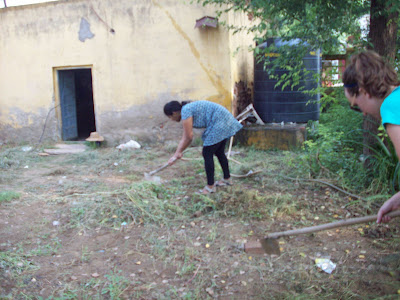
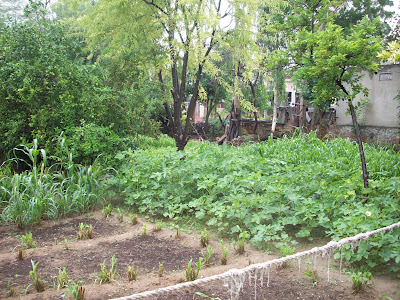
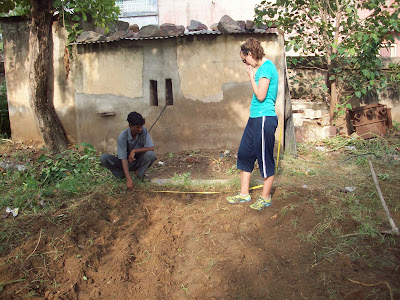
There is no time for sleeping in when you’re out in the field: Kate, Vaish and I were at the COCO 7:45 am. After surveying land behind the building, and mentally deciding where we wanted to set up the evaporation pond and the garden, we get to work on clearly the vegetation and trash. We are still waiting to hear back from our plant guy in Jhunjhunu, so after we get the land cleared we get to work on the evaporation pond.

From Sarvajal- Bagar, Week 1

While working, Bula brought us piping hot chai tea to take a break and “cool” off from the work. It was (and always is) quite tasty, but it didn’t exactly do much to help cool us off. During this chai break, we asked Shiv Ratan and Bula not to throw trash out behind the building anymore. They agreed, and then Bula immediately took our empty plastic chai cups and threw them over the wall separating the property from the road. Even though Vaishnavi’s Hindi is getting better each day, I think something got lost in the translation of our request.

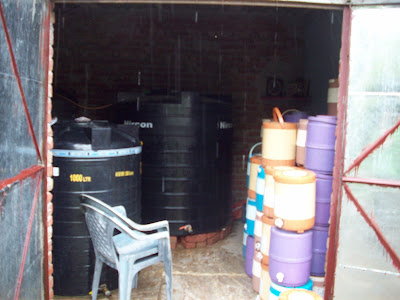
With some help from Shiv Ratan (the operator of the COCO) we are able to dig out a ~4 inch deep pit that is 5 feet by 9 feet in size. Conveniently, it was time for him to run the RO machine to produce drinking water, which meant we were able to collect some brine for our evaporation pit. After fixing some some holes in the plastics and filling up a 21 liter jug 5 times (Vaish and Kate have some serious upper body strength!) our pit was ready. We took some key measurements- including the depth of the water and the Total Dissolved Solids (TDS) level. We also had a bit of luck and found some algae in the RO brine, which we saved to use in a different experiment.
After these tasks, it was now 10 am and starting to get quite steamy out, so we decided to take a break (and showers!) back in our rooms and then go back to our office in the afternoon. Around 3:30 pm we got a call from Kuldeep, who we had met in the Jaipur office. He was in Bakhtawarpura, a town which was a 15 rupee bus ride (~30 cents) up the road from Bagar, and offered to show us around. He led us to his family’s “town” house where we met his grandma, uncle, and aunt and drank chai tea. His family seemed very friendly, but his grandma only spoke the local language. So at any given point in the conversation, there were 2 sets of translations going on: Vaish to Kate and I and Kuldeep to his Grandma. We were then taken on a tour where we saw an ornately painted house that was over 250 years old.

From Sarvajal- Bagar, Week 1

From Sarvajal- Bagar, Week 1

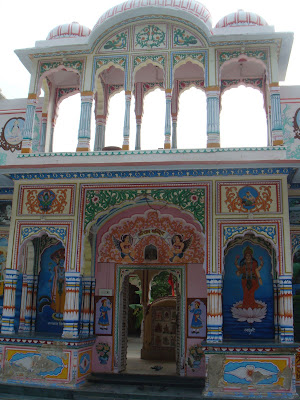
We were then taken to a temple that was dedicated to Krishna. We went inside and all three of us walked around the altar three times- we had to be careful not to get in the way of another woman, who seemed to be deep in mediation (walking the same path several times is a form of mediation).
From Sarvajal- Bagar, Week 1

We also noticed some awesome solar powered street lamps!

From Sarvajal- Bagar, Week 1

We met with the local Sarpanch (essentially a mayor) who helped Bakhtawarpura win multiple awards for the village’s cleanliness and its water system. Kuldeep is standing next to me and the Sarpanch is in the middle.

From Sarvajal- Bagar, Week 1

We then walked a “kilometer” out to Kuldeep’s family farm (it was not a great day for us to wear sandals). Along with taking in the beautiful scenery, we also met his father, who was working on the family’s small dairy. One of their cows was only born with 3 legs, but he seems to be doing just fine.

From Sarvajal- Bagar, Week 1

After the dairy we went to see his family’s "farm" house; where we meet his mother, his two sisters, and his brother. His sister made us the most delicious chai tea we’ve had yet- which was made from milk from their dairy! After tea, we went out to inspect the farm’s irrigation system, but were distracted by a bunch of baby goats! They were so adorable and wanted to jump around everywhere! One was a little boy goat, who was quite frisky. Upon noticing that Kate was excited to see the baby goats, Kuldeep’s mother picked the frisky one and practically threw it at Kate for her to hold!

From Sarvajal- Bagar, Week 1

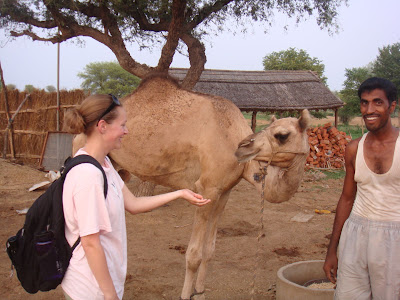
After inspecting the irrigation system, which uses water from a well and pipes it down-hill to the sprinklers with a 20 foot radius, we went over to a neighbor’s house to ask to have some pepper plants for our garden. They were very happy to help us and even tried to give us other food as well. As an added bonus, I got to get my picture taken with their camel!
From Sarvajal- Bagar, Week 1

On the long walk back to the bus stop, we also stopped and picked up an aloe vera plant from Kuldeep’s field. He walked us back to the bus stop and waited until we got on. After the crowded bus ride back to Bagar and a late dinner, it was finally time for some much needed sleep!

From Sarvajal- Bagar, Week 1

Saturday, July 16, 2011

Shopping for supplies

A 15 minute bus ride at 9:30am in an overcrowded public bus found us on the streets of Jhunjhunu searching for supplies for our project. After picking up some general cleaning supplies for our room (which Kate is using right now!) we got down to business and went looking for a hardware store. A share auto ride of Rs5 per person got us to the right part of town and looking in a few stores we found some black plastic sheets, string, a mesh scoop, some measuring tape and others bits and pieces. We also did do a little shopping for scarves (absolutely essential to protect your head from this heat!) and also picked up some fruits. The plants we are looking for were not available, but the kind nursery owner offered to look for them in Sikar, another big town a couple of hours away. A bus ride back to Bagar, during which Kate made a friend from Lamba (a village nearby) who is working in the UAE now, a good lunch and then back to the office to get some work done.


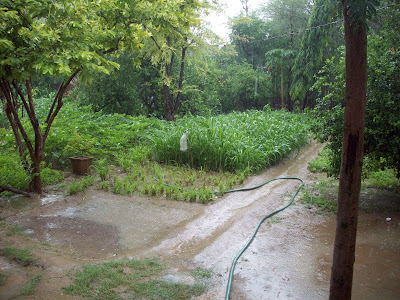
And while we were working it finally started to rain! Which may sound strange- most of the time no one likes rain. But in India, the rain helps cool things off... at least for a little bit. The rain also helped us make a new friend. Lizards are fairly common here, but this one seems quite fond of the window in our office. He is so cute, we may just have to make him our unofficial office pet!


Friday, July 15, 2011

Finally in Bagar- Time to get to work!

After waking up at 6:30 am and a 5 hour bus ride, we finally arrive in Bagar! Sarvajal chose this site for us because it houses a Company Owned, Company Operated RO machine; which is affectionately referred to as a COCO. This means we can run our experiments and pilots without jeopardizing any franchisee’s business. Not that we plan on causing any chaos, but it is nice to know we won’t be too much of a hassle. Bagar is also the home town of the Piramals- the prominent family that started Piramal Enterprises (the umbrella organization of Sarvajal).
Aditya and ­­­­Tarun came to meet us at the bus, showed us our rooms, the restaurant where we will be having our meals, the Sarvajal office where we will step-up shop and the COCO. Everyone at the office has been helpful and nice; despite the Hindi/English language barrier (thank goodness for Vaishnavi!). Tomorrow we plan to travel the 10 km back to Jhunjhunu to pick up supplies for both ourselves and the project. It promises to be an interesting day, so make sure to read tomorrow’s post!
From Sarvajal- Bagar, Week 1

Thursday, July 14, 2011

Jaipur

From Headquarters in Ahmedabad, Gujarat, we traveled on an overnight bus to Jaipur in the state of Rajasthan. We hit the ground running and after meeting staff at the Jaipur office, we ventured out to visit two Sarvajal franchises in the area.

Despite a rainy auto-rickshaw ride getting there…..

From Sarvajal- Jaipur

Our first stop was in Pratap Nagar. This franchise is run by Suresh Saini and his large family. Suresh was kind enough to meet us at the main road and show us the way back to his franchise in the middle of a residential neighborhood. We walked through a beautiful garden with vegetables and fruit trees – immediately wondering if Suresh was using brine to water his plants….

From Sarvajal- Jaipur

Turns out he is! And more on that in a minute….

From Sarvajal- Jaipur

Suresh has been in operation for about four months. He currently serves 200 customers in the area, 170 of which collect water daily. The majority of his business is deliveries with only some customers purchasing directly from the RO plant. His machine runs approximately five hours per day. His raw water comes from a well with a TDS level of 550 and he delivering product with a TDS level of around 70-80.

He has been using the brine to water his garden every since the RO plant was installed. So far he hasn’t noticed any difference in the growth of his plants or the taste of his vegetables. He suspects the TDS of the brine is about 1100. He produces approximately 2000 liters of brine per day, all which goes to his garden. Outside of monsoon season, that 2000 liters isn’t enough so he supplements it with well water.

Suresh’s garden yields only enough for his family- but with 8 brothers that’s a lot of mouths to feed! The garden has pomegranate, guava (amrud) fruit and papaya trees. He also grows mint, okra, eggplant, leshua, gavari phali, bajra and lentils.

From Sarvajal- Jaipur

He also uses the brine in his house for domestic use such as mopping the floor, laundry, doing dishes and for bathing. They have not reported any problems with using brine for this purpose. If there is any excess brine left after his use (which happens in the monsoon), he allows neighbors to take the brine through a pump for their domestic and garden use.

He has yet to recoup his initial investment but he’s confident that he will soon. He estimates that he needs approximately 300-350 customers total in order to turn a profit. He sold his first 200 customers by bringing samples door to door and letting people try it for free. His operating costs are about 1500Rs per month for electricity. In order to offer the delivery service, the added expense includes rent for the Tempo (mini truck) to deliver the water at 550Rs per day (including fuel). The Tempo driver costs 500Rs per month. Suresh also has four employees that he pays 150Rs per person per day

One the added benefits he provides his customers is chilling the water. One of his holding tanks is insulation and connected to a cooling unit that dispenses the chilled water into insulated jugs that he delivers to customers.

From Sarvajal- Jaipur

The next franchise was in an industrial area and a bit more difficult to find – but we got lucky with an auto driver who was willing to take on the challenge and after circling the block a number of times.

From Sarvajal- Jaipur

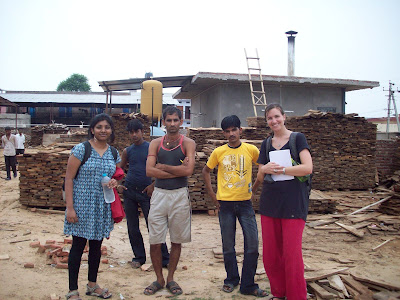
There we found Sanvarmal Jhangid who runs a franchise in Sitapura. The RO machine is housed in a building within the gates of his lumberyard where he treats wood for his large furniture making business.

From Sarvajal- Jaipur

From Sarvajal- Jaipur

Half of the brine he produces is used in a machine to treat wood. The raw lumber is loaded into a large chamber and soaked in brine mixed with chemicals.

From Sarvajal- Jaipur

We asked what he does with the chemicals after the wood is treated. He told us that 3/5 of the brine-chemical mixture is absorbed into the wood in one treatment and then he puts the remaining mixture towards the next batch meaning he never has to dump it. He explained that the fluoride in the brine actually helps with the treatment of the wood and he can use less total water as a result. He’s been doing this for approximately two months and hasn’t noticed any difference in the integrity of the wood or any adverse affects to his final product.

Wednesday, July 13, 2011

Headquarters Day 2: Lessons Learned

After two days at headquarters, here’s what we learned:

The need for clean water
Clean water isn’t convenient. In a large municipal system, such as the one in Delhi, only about 40% of water piped from the source actually reaches consumers due to cracks in the piping. Cross contamination with sewage is also a significant problem- making water quality unpredictable. It is also costly to pipe water long distances- a particular challenge in rural areas.
Sarvajal realized that a community-based model is more suited to remote areas. As such, Sarvajal operates a “cluster” model with concentrated areas and hubs which allow for central territory offices to provide the needed support and maintenance in a specified geographic area while reaching out concentrically to more and more remote areas. Franchises are currently organized in clusters (which are part of these larger territories) and Sarvajal is expanding around their current hubs in both Rajisthan and Gujarat.

From Sarvajal-Ahmedabad


One of the main challenges Sarvajal faces in its mission to provide safe and affordable drinking water is educating people about the risks associated with consumption of municipal water. The mineral content in the water makes it unsafe to drink- Fluoride being the worst offender as it causes something called Flourosis which leads to joint pain, water accumulation in the legs and other painful health issues. (Sarvajal has not detected any issues with other common water contamination problems such as arsenic, lead, iron or silica.)

In Rajisthan and Gujarat- both arid desert regions that experience a massive increase in rainfall during the monsoon season, seasonal variability (both in terms of weather and fluctuating demand for water) presents a challenge in North India.

In a town like Bagar (where we will be conducting the majority of our experiments) most people have access to municipal water and bore wells. Domestic water use is anything from bathing and laundry to cooking and straight consumption. Sarvajal is attempting to replace municipal and well water intended for consumption with clean, purified water. (Some people in Bagar have domestic RO units however they are incredibly inefficient producing only 1 liter of clean water for every 9 liters of brine.)

In India drinking water makes up about .8% of all water use is drinking water- so while we’re not dealing with a significant volume (whereas agriculture for example constitutes 80% of water use) the responsible management of this water is crucial in this arid region.


Water for all

In India there is a culture that water, particularly well water, is free. It is a right not a privilege that everyone have access to that water. As the water has become contaminated, however, it has to be cleaned for obvious health reasons and that costs money. There is a challenge in convincing people that the water their family has been drinking for centuries is not safe to drink. The real challenge is then convincing people to pay for something they think they expect to get for free.

The reason our team from the U-M is here is to find creative solutions for waste water- and there are clear economic and environmental reasons why this matters.


Sarvajal employs Reverse Osmosis (RO) combined with basic filtering and UV technology to purify groundwater for drinking. Their technology is 4 times as efficient as domestic RO plants .


The Sarvajal model
Government and many non-profit water assistance programs have proved unsustainable in efforts to provide consistently clean, affordable drinking water- it requires a lot of time to build partnerships and costs a lot of money to keep programs in operation. That’s why the Sarvajal model employs market-based solutions, partnering with local entrepreneurs to market, produce and distribute Sarvajal water. The model certainly provides incentive to get clean water in the hands of people who need it but it also means they are susceptible to market fluctuations and other vulnerabilities.


Reverse Osmosis
Sarvajal employs Reverse Osmosis (RO) combined with basic filtering and UV technology to purify groundwater for drinking. Machines run at 40% efficiency (at a 5 to 8 ratio meaning for every 5 liters of ‘product’ they are producing 8 liters of waste). The purpose for this to keep the brine diluted enough so that it can be disposed of. The RO membranes are rated for up to 65% efficiency.

From Sarvajal-Ahmedabad


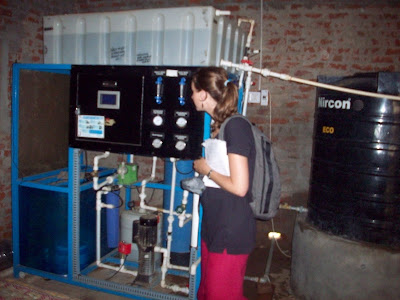
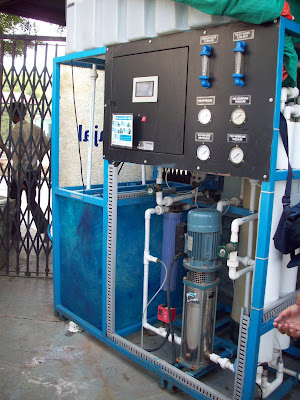
The very first COCO (Company Owned, Company Operated) RO machine was installed in Bagar. This RO machine (1000 LPH- Liters per hour) is much bigger than the model they currently use in other franchise locations (but the brine is the same).

From Sarvajal-Ahmedabad

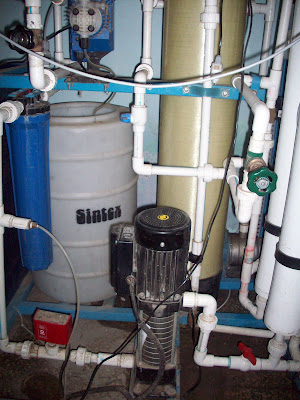
Water at franchisee locations is pumped from ground wells. Most RO franchises have a well and a pump owned by the franchisee. This pipes to a 500 liter raw water storage tank on top of the RO machine. From there it passes through a charcoal filter, two RO membranes, UV and into a clean water storage tank where it can be dispensed to customers.

The RO machines have been designed to be as compact and simple as possible. They can be installed within 4 hours and have wheels and handles so they can even be moved by a single person. For easy transport to remote areas, they also fit on the back of a Tempo (a commonly used miniature pick-up truck.) Installation requires access to water and electricity (for running the pumps and data tracking equipment).

Getting water
Customers either pick up water for 30 paise (.007 cents) per liter or have it delivered for 50 paise per liter. Water is usually delivered in 20 liter drums.


Franchise owners prepay Sarvajal for the water and then collect payment from customers. Before prepay Sarvajal was only getting about 70% of revenues. Now, with prepay they get about 107%.

Savajal gets a 40% cut of profits which pays for maintenance, running the headquarters office and other business expenses. The franchisee’s 60% cut breaks down into approximately 20% in operation costs and 40% earnings. The initial investment to become a franchise is about 50,000 Rs.

Communications
Headquarters communicates with franchisees through a number of avenues- FRM (Franchisee Relationship Management) staff conduct site visits 1-2 times per month in addition to weekly phone calls. They also host quarterly franchisee meets where franchisees from a particular cluster get together to share ideas and learn about new initiatives or technologies being employed by Sarvajal. There are about 2-3 administrative staff people in each territory.

Data tracking
Sarvajal maintains a sophisticated data tracking system. The remote data tracking “Soochak” (which means indicator or information provider”) has improved not only consistency regarding the safety of the water dispensed but ensures that franchisees report actual sales. Twelve data collection sensors on each RO machine report almost real-time data where staff at Headquarters can monitor flows, TDS levels (Total Dissolved Solids) and maintenance issues. The machine transmits data through cellular technology meaning each machine sends about 1000 texts per month.

From Sarvajal-Ahmedabad


Water is tested regularly by Sarvajal (both inputs and outputs) as well as local governments who control the source of municipal water (which in many villages fluctuates depending on which well is cleanest at any given time.)

Tuesday, July 12, 2011

Day 1- Headquarters

We arrived at headquarters at 11am (the work day starts at 10a!) to be greeted by Priyanka, Sameer and the rest of the friendly staff at the Sarvajal offices in Ahmedabad. There are also two interns here – one from U-M's own Ross School of Business and another from Dartmouth.
After taking care of logistics – accommodation, transportation, etc. – We jumped right in to a presentation on Sarvajal’s business model and conversations about solutions for the RO brine.

We also got our first taste of Sarvajal water!


After meetings and a quick bite to eat we got a demonstration of the RO Machine (more on that later) and took a tour of the new water ATMs Sarvajal is piloting in Ahmedabad.

Water ATMs
Most villages have less than 100 families and can’t really support their own RO machine. In order to get water to these villages, Sarvajal developed water ATMS using the same RFID (Radio Frequency Identify Device) technology they employed with the Soochak (more on that later). Customers purchase a prepaid RFID card, which debits the amount (at 30 paise per litre) they dispense from the machine in 5-, 10- and 20-liter quantities. The machine has displays for showing the balance on the card as well as the TDS (Total Dissolved Solids) levels. We visited pilot installations in Tekra-a slum in Ahmedabad- to see the "Water ATMs" in action.

Monday, July 11, 2011

Welcome to India!

We were greeted in Ahmedabad today by driving rain and flooded roads- welcome to India during the monsoon! After hydroplaning in the taxi to the hotel we prepared for our meetings at headquarters tomorrow. After dinner the rain stopped, things dried out a little- and we’re hoping this is a sign of things to come….The trouble with timing our site visit with the monsoon is obvious – but we’re staying optimistic and hoping the weather cooperates for the next 5 weeks.

Vaishnavi and Kate waiting at the airport for Lauren to arrive


Lauren arriving after her 20+ hour journey from Detroit