Wednesday, July 13, 2011

Headquarters Day 2: Lessons Learned

After two days at headquarters, here’s what we learned:

The need for clean water
Clean water isn’t convenient. In a large municipal system, such as the one in Delhi, only about 40% of water piped from the source actually reaches consumers due to cracks in the piping. Cross contamination with sewage is also a significant problem- making water quality unpredictable. It is also costly to pipe water long distances- a particular challenge in rural areas.
Sarvajal realized that a community-based model is more suited to remote areas. As such, Sarvajal operates a “cluster” model with concentrated areas and hubs which allow for central territory offices to provide the needed support and maintenance in a specified geographic area while reaching out concentrically to more and more remote areas. Franchises are currently organized in clusters (which are part of these larger territories) and Sarvajal is expanding around their current hubs in both Rajisthan and Gujarat.

From Sarvajal-Ahmedabad


One of the main challenges Sarvajal faces in its mission to provide safe and affordable drinking water is educating people about the risks associated with consumption of municipal water. The mineral content in the water makes it unsafe to drink- Fluoride being the worst offender as it causes something called Flourosis which leads to joint pain, water accumulation in the legs and other painful health issues. (Sarvajal has not detected any issues with other common water contamination problems such as arsenic, lead, iron or silica.)

In Rajisthan and Gujarat- both arid desert regions that experience a massive increase in rainfall during the monsoon season, seasonal variability (both in terms of weather and fluctuating demand for water) presents a challenge in North India.

In a town like Bagar (where we will be conducting the majority of our experiments) most people have access to municipal water and bore wells. Domestic water use is anything from bathing and laundry to cooking and straight consumption. Sarvajal is attempting to replace municipal and well water intended for consumption with clean, purified water. (Some people in Bagar have domestic RO units however they are incredibly inefficient producing only 1 liter of clean water for every 9 liters of brine.)

In India drinking water makes up about .8% of all water use is drinking water- so while we’re not dealing with a significant volume (whereas agriculture for example constitutes 80% of water use) the responsible management of this water is crucial in this arid region.


Water for all

In India there is a culture that water, particularly well water, is free. It is a right not a privilege that everyone have access to that water. As the water has become contaminated, however, it has to be cleaned for obvious health reasons and that costs money. There is a challenge in convincing people that the water their family has been drinking for centuries is not safe to drink. The real challenge is then convincing people to pay for something they think they expect to get for free.

The reason our team from the U-M is here is to find creative solutions for waste water- and there are clear economic and environmental reasons why this matters.


Sarvajal employs Reverse Osmosis (RO) combined with basic filtering and UV technology to purify groundwater for drinking. Their technology is 4 times as efficient as domestic RO plants .


The Sarvajal model
Government and many non-profit water assistance programs have proved unsustainable in efforts to provide consistently clean, affordable drinking water- it requires a lot of time to build partnerships and costs a lot of money to keep programs in operation. That’s why the Sarvajal model employs market-based solutions, partnering with local entrepreneurs to market, produce and distribute Sarvajal water. The model certainly provides incentive to get clean water in the hands of people who need it but it also means they are susceptible to market fluctuations and other vulnerabilities.


Reverse Osmosis
Sarvajal employs Reverse Osmosis (RO) combined with basic filtering and UV technology to purify groundwater for drinking. Machines run at 40% efficiency (at a 5 to 8 ratio meaning for every 5 liters of ‘product’ they are producing 8 liters of waste). The purpose for this to keep the brine diluted enough so that it can be disposed of. The RO membranes are rated for up to 65% efficiency.
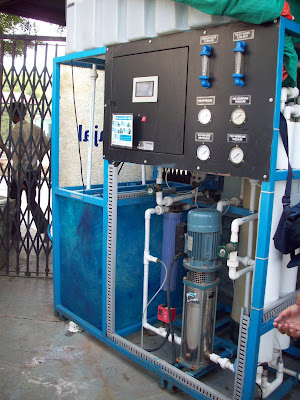
From Sarvajal-Ahmedabad


The very first COCO (Company Owned, Company Operated) RO machine was installed in Bagar. This RO machine (1000 LPH- Liters per hour) is much bigger than the model they currently use in other franchise locations (but the brine is the same).
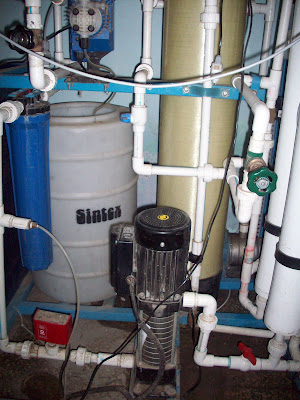
From Sarvajal-Ahmedabad

Water at franchisee locations is pumped from ground wells. Most RO franchises have a well and a pump owned by the franchisee. This pipes to a 500 liter raw water storage tank on top of the RO machine. From there it passes through a charcoal filter, two RO membranes, UV and into a clean water storage tank where it can be dispensed to customers.

The RO machines have been designed to be as compact and simple as possible. They can be installed within 4 hours and have wheels and handles so they can even be moved by a single person. For easy transport to remote areas, they also fit on the back of a Tempo (a commonly used miniature pick-up truck.) Installation requires access to water and electricity (for running the pumps and data tracking equipment).

Getting water
Customers either pick up water for 30 paise (.007 cents) per liter or have it delivered for 50 paise per liter. Water is usually delivered in 20 liter drums.


Franchise owners prepay Sarvajal for the water and then collect payment from customers. Before prepay Sarvajal was only getting about 70% of revenues. Now, with prepay they get about 107%.

Savajal gets a 40% cut of profits which pays for maintenance, running the headquarters office and other business expenses. The franchisee’s 60% cut breaks down into approximately 20% in operation costs and 40% earnings. The initial investment to become a franchise is about 50,000 Rs.

Communications
Headquarters communicates with franchisees through a number of avenues- FRM (Franchisee Relationship Management) staff conduct site visits 1-2 times per month in addition to weekly phone calls. They also host quarterly franchisee meets where franchisees from a particular cluster get together to share ideas and learn about new initiatives or technologies being employed by Sarvajal. There are about 2-3 administrative staff people in each territory.

Data tracking
Sarvajal maintains a sophisticated data tracking system. The remote data tracking “Soochak” (which means indicator or information provider”) has improved not only consistency regarding the safety of the water dispensed but ensures that franchisees report actual sales. Twelve data collection sensors on each RO machine report almost real-time data where staff at Headquarters can monitor flows, TDS levels (Total Dissolved Solids) and maintenance issues. The machine transmits data through cellular technology meaning each machine sends about 1000 texts per month.

From Sarvajal-Ahmedabad


Water is tested regularly by Sarvajal (both inputs and outputs) as well as local governments who control the source of municipal water (which in many villages fluctuates depending on which well is cleanest at any given time.)

Tuesday, July 12, 2011

Day 1- Headquarters

We arrived at headquarters at 11am (the work day starts at 10a!) to be greeted by Priyanka, Sameer and the rest of the friendly staff at the Sarvajal offices in Ahmedabad. There are also two interns here – one from U-M's own Ross School of Business and another from Dartmouth.
After taking care of logistics – accommodation, transportation, etc. – We jumped right in to a presentation on Sarvajal’s business model and conversations about solutions for the RO brine.

We also got our first taste of Sarvajal water!


After meetings and a quick bite to eat we got a demonstration of the RO Machine (more on that later) and took a tour of the new water ATMs Sarvajal is piloting in Ahmedabad.

Water ATMs
Most villages have less than 100 families and can’t really support their own RO machine. In order to get water to these villages, Sarvajal developed water ATMS using the same RFID (Radio Frequency Identify Device) technology they employed with the Soochak (more on that later). Customers purchase a prepaid RFID card, which debits the amount (at 30 paise per litre) they dispense from the machine in 5-, 10- and 20-liter quantities. The machine has displays for showing the balance on the card as well as the TDS (Total Dissolved Solids) levels. We visited pilot installations in Tekra-a slum in Ahmedabad- to see the "Water ATMs" in action.

Monday, July 11, 2011

Welcome to India!

We were greeted in Ahmedabad today by driving rain and flooded roads- welcome to India during the monsoon! After hydroplaning in the taxi to the hotel we prepared for our meetings at headquarters tomorrow. After dinner the rain stopped, things dried out a little- and we’re hoping this is a sign of things to come….The trouble with timing our site visit with the monsoon is obvious – but we’re staying optimistic and hoping the weather cooperates for the next 5 weeks.

Vaishnavi and Kate waiting at the airport for Lauren to arrive


Lauren arriving after her 20+ hour journey from Detroit

Thursday, June 9, 2011

Evaporation, Catchment, Re-Run: Part 1

In our initial conversations with Sarvajal managers, we learned that each franchise location discards 3000-5000 liters of reject water (RO brine) per day.

On an industrial scale, this may not seem like a lot, but when you’re thinking of growing local operations in a water-stressed region it starts to add up. It makes a compelling case for conservation for conservation’s sake and it also reveals an opportunity for proactive business adaptation strategy. Not only is it in Survival’s best interest to conserve the supply of fresh water available in underwater aquifers, there may also be financial pay-offs down the road for maximizing capacity for efficient resource use today.

As it stands, the existing incentive structure does not lend itself to efficient or sustainable water use. Well water is free to franchisees and there are no restrictions on withdrawing or discarding unused water. However, Sarvajal franchisees do pay for energy and maintenance. Given that running reverse osmosis machines at their highest efficiency both increases wear and tear and energy consumption, inefficient water use makes good business sense… for now.

But business-sense aside, Sarvajal recognizes the social imperatives to use communal resources as responsibly as possible. Our challenge is to find ways to encourage and enable more conservative water use that will not raise operating costs for Sarvajal’s franchisees.

One possible approach to this challenge is to find ways to use reject water from Sarvajal’s operations in a complimentary business venture. Running public toilets, kiln cooling or aquaculture operations with the brine may generate additional income for entrepreneurs which would shift the incentive structure all together. However, these options each require launch an entirely new business. Where barriers to launching a complimentary business venture are prohibitive, there may be another option to recover and utilize as much water as possible under current Sarvajal operations: evaporation, catchment and rerun of the reject water.

Wednesday, June 8, 2011

Laundry solution

The RO Brine could potentially be re-used to do laundry. In rural areas, the large quantity of brine can be used in a communal laundry facility. The brine could be pumped to any existing communal laundry location in the village/ town, and if such a facility does not exist, any empty piece of land close to the franchisee could be made into one. The benefits of this would not just be the re-use of the reject brine, but also reduction in the use of virgin groundwater for laundry. This could also be a moneymaking venture for the franchisee. If the people are charged for the water they use every-day, then this brine could be provided at a lower cost to the users for laundry. Another advantage of this solution would be that it would serve as a communal gathering for the women, and thereby provide social benefits. Even in urban-areas the reject brine could be used in Laundromats, either owned by the franchisee or pumped to an external Laundromat close by.

The problem with this idea is the effect the brine would have on clothes. When used with regular laundry detergent, the RO brine does not let it foam much. When in Rajasthan, we intend to do some water quality testing and also physically test if the reject affects the quality of the clothes. Another barrier to this solution could be objection from the end users. This is something we will learn more about by interacting with them when we are on the field.

Tuesday, June 7, 2011

Public Restroom Facility: One Possible Solution

When brainstorming possible uses for the reverse osmosis (RO) brine, one of the first ideas we came up with was to use the brine in place of water in a public restroom facility. This solution could easily use brine to flush human waste and it would provide a hygienic method of storing the waste- improving public health in the community. In order to make this solution economically viable, it would be a good idea to incorporate a “pay-per-use” system at this facility. Local residents would be familiar with this system because it is a similar one used at Sarvajal franchisee locations and it would create an economic opportunity for another local resident.

Being a more socially minded person, I started my research with the current practices and cultural norms of the region and how these norms would affect the ultimate physical structure of the facility. Currently, in most rural areas of India there is no central water or waste infrastructure and open defecation around the villages (often in nearby fields) is common. This poses obvious risks to public health, especially considering India’s rapidly growing population. It became apparent that any public restroom facility would need to be accompanied with an educational program on how to use the facility and why it is needed, because residents may never have seen any such facility.

A critical consideration is the social stigma associated with removing and handling human waste. It is a job only performed by the lowest castes of Indian society. Our group recognized this as a potential barrier to implementation, but since we did not know which of the 100+ Sarvajal locations we would be working at, we did not yet know the exact social dynamics of the villages. No resolution for dealing with this stigma was determined, but it was left open for further consideration and development once more site-specific information was obtained.

Another important societal norm I discovered was the need for women to preserve their modesty in all situations. Since the only place available to relieve oneself was outside, this often meant that women had to wake up before sun rise or wait until sunset to relieve themselves, in order to avoid being seen in a revealing position. In order to accommodate modesty concerns, a public restroom facility would need to have two rooms (one for each gender), doors, and a roof.

The need for privacy, and therefore an enclosed space, made the next task of how to eliminate foul smelling odors crucial. I did not want to incorporate a ventilation system because I wanted to keep the cost down in hopes of making this solution scalable to multiple franchisee locations. After researching a variety of public restroom facility designs, I choose a system with a holding tank below ground. In a holding tank containing brine, the waste would be below the surface of the brine, foul odors would be greatly reduced; increasing the likelihood that such a facility would actually be used.

This research into structural design also lead me to a system known as “pour-flush” system. After a person uses the facility they would turn on a faucet to fill a bucket with water (or in our facility with brine) and then pour it into the hole to flush the waste down into the holding tank. This method seemed the most practical because it would ensure that brine was always present in the holding tank. It was also very simple to construct and use; it would not require a lot of technical maintenance.

My next step was to review the water quality to make sure that any contact with the brine during the pour-flush process would be safe. Around this time, our group held a solutions symposium with some engineering students to get technical feedback on our solution designs. One student mentioned that my design seemed to be on the right track, but that I needed to check to see if our brine contained sulfates. When sulfates come into contact with organic material (such as human waste) it reacts to form hydrogen sulfide. Concentrations as low as 0.00047 ppm create the typical “rotten egg” odor, 50-100 ppm can cause damage to the eyes and if the concentration reaches 320-530 ppm pulmonary edema becomes likely and death can occur (USEPA). After the symposium I checked the water quality data sent to our group by Sarvajal- almost every franchisee location has sulfate in their ground water; which would ultimately be concentrated in the brine after the reverse osmosis process.

Upon learning this information, it was determined that further research and development on this solution should be suspended. While I still believe that a public restroom facility would have a profound impact in the village(s), given the potential chemical reactions this solution is not feasible to pilot test with current technology and budget restraints.


Works Cited

USEPA. (1980). Health and Environmental Effects Profile for Hydrogen Sulfide p.118-8. ECAO-CIN-026A


A 'basket' of solutions

Looking into reusing or reducing the reject brine from reverse osmosis, mainly in rural India as well as a few urban centers, for our client, Piramal Water Private Limited, our team brainstormed to come up with a number of creative as well as technical solutions. Each solution we came up with was evaluated based on practical considerations (scalability, viability, short-term feasibility, suitability), economic considerations (cost effectiveness, added economic value) and social considerations (community value and cultural sensitivity).

Under a business as usual scenario, the RO system is run at approximately 40% and the brine is discarded to either evaporate or recharge into the water table. This solution would not add any economic or social value and would contribute to environmental degradation.

The reject brine could potentially be used for laundry purposes by piping it to a communal laundry facility in rural areas or used in a commercial laundromat in urban settings. This would depend on the contents of the brine and the effect it would have on clothes. This is a solution we propose to pilot test.

Another idea looks at using the reject brine in a public restroom facility. It would add immense social value, especially in rural areas, but various social and cultural norms would have to be studied as well as the contents of the brine to understand the feasibility of this solution as well as the laundry idea.

A potential revenue generating solution that we came up with is using the brine for Aquaponics, which is essentially combining the technology of aquaculture (raising fish in tanks) with hydroponics (cultivating produce in water). Initial investment costs might be a hurdle for this solution.

Bioaccumulation is a potential solution to clean the reject brine. Certain plants that can bio-accumulate pollutants can be grown in the brine and the cleaned water can be re-used for other purposes or even re-run through the RO again. A major hurdle for this is to find plants that would accumulate salt. We are looking at the feasibility of pilot testing this idea.

Our most promising idea is evaporation of the brine to harvest salt. Incorporating water reclamation into the evaporation system would enable using the reclaimed water to cut the additional brine for re-run. This is another solution we intend to pilot test.

The brine could also be used for beautification/ landscaping, to develop a small garden/ park in the village or outside the franchisee outlet. This would involve investment by the franchisees, for which they might not be willing.

A solution to treat the RO brine is by infiltration to a treatment wetland, including native plants where possible. The brine would get treated as it percolates back to the ground water table. This would improve groundwater quality compared to business as usual but involves capital costs to set up, for which the willingness of the client would be needed.

The technical solution our team is looking at is further treatment through Capacitive Deionization. It is a process the removes salts and minerals from water by applying an electric field between two porous electrodes. It has been utilized along with biologically activated carbon to further treat RO brine with up to 90% reductions in total dissolved solids concentrations. Again the capital costs associated do not make this a feasible solution for our client.

Testing the brine for its contents, understanding the social and cultural norms of the locals which would lead to acceptance of any pilots and willingness of the franchisees to invest in the solutions are some of the issues we will be looking to further research in July/ August, 2011 when our team visits franchisees of Piramal Water Private Limited in Gujarat and Rajasthan.